


How to Prevent Coating Runs in Spray Finishing

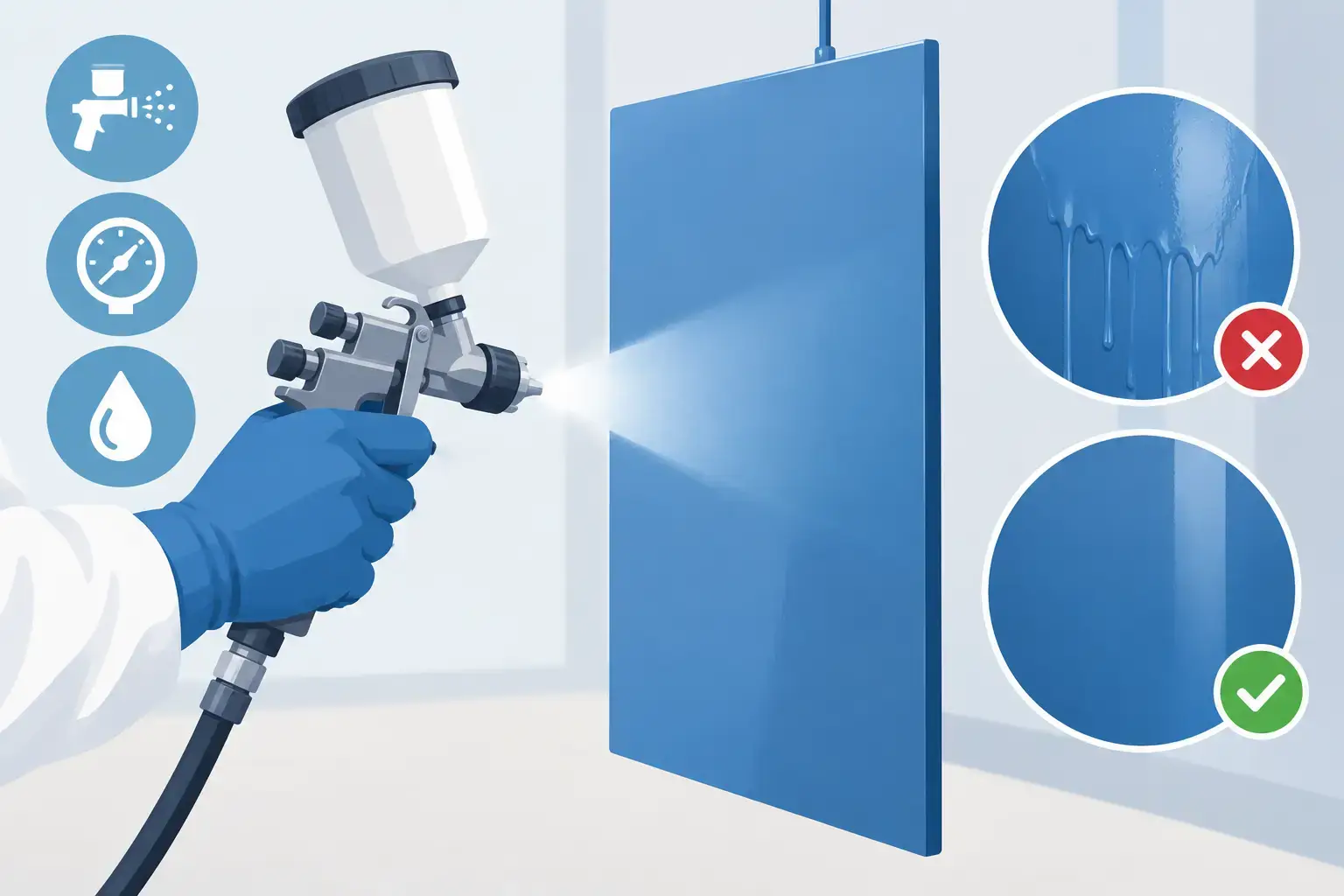
A run is not simply a cosmetic defect. It can mean extra flatting and polishing, a rejected part, lost booth time and inconsistent quality across a batch. Understanding how to prevent coating runs starts with recognising that they are usually caused by too much wet material reaching one area before it has had enough time or airflow to hold in place.
For bodyshops, joinery workshops, metal fabricators and production facilities, the answer is rarely just to tell an operator to spray faster. Material selection, gun settings, component position, booth airflow and flash-off conditions all affect whether a coating flows out correctly or starts to sag.
Why coating runs happen
A coating run occurs when the wet film becomes too heavy for the surface tension and viscosity of the coating to support it. Gravity then pulls the material down the panel or component. The result may be a visible curtain, a narrow tear-shaped run, or a heavy edge where paint has collected.
Runs are more likely on vertical surfaces, internal corners, lower edges and complex shapes where spray passes overlap. They can also appear on horizontal surfaces when excess material pools around holes, recesses or sharp changes in profile.
The immediate cause is typically excessive film build, but the contributing factors vary. A low-viscosity mix, an over-open fluid needle, a slow pass speed, poor atomisation or insufficient flash-off between coats can all leave too much wet coating on the surface. Low air movement or unsuitable temperature can make matters worse by slowing solvent evaporation.
Set the coating up correctly before spraying
Material preparation is one of the most reliable ways to prevent coating runs. Always work to the coating manufacturer’s technical data sheet, including mixing ratio, thinner or reducer choice, induction time where specified, pot life and recommended spray viscosity.
A coating reduced beyond its recommended range may atomise easily but can lose the body needed to stay on a vertical face. Conversely, material that is too viscous may encourage an operator to turn up fluid delivery or spray closer to the work, which can create heavy, uneven application. The correct balance depends on the product, the spray equipment and the workshop conditions.
Temperature matters at this stage. Cold paint, cold components and a cold spray area can affect viscosity, flow and flash-off. Material should be allowed to reach the supplier’s recommended application temperature before mixing and spraying. Heating a product without checking its data sheet is not a substitute for proper control, particularly with two-pack systems.
Strain the coating before it enters the gun. This will not prevent runs directly, but it helps maintain a stable fan pattern and reduces the temptation to compensate for poor atomisation with extra fluid.
Match thinner speed to the conditions
Thinner or reducer selection needs particular care. A fast thinner can flash quickly and may increase dry spray or poor flow-out in a warm booth. A slow thinner can keep the film wet for longer, increasing the risk of sagging, especially on vertical work or during cooler, low-airflow conditions.
There is no single thinner speed that suits every job. Consider the product, ambient temperature, panel size, film build and ventilation conditions. For example, a large fabricated frame may need a different approach from a small repair panel because the operator needs longer to maintain a wet edge across the whole item.
Adjust the gun for controlled film build
Spray gun settings should deliver an even fan with enough atomisation to lay down a consistent film, not the maximum possible volume of material. Too much fluid, a narrow fan or low atomising pressure can deposit excessive paint in a small area.
Start with the equipment manufacturer’s baseline settings, then confirm the fan pattern on a test card. A clean, even pattern with balanced distribution is the aim. Heavy ends, a centre-heavy pattern or intermittent output indicate that the gun, air supply or material feed needs attention before production work begins.
Keep the fluid control open only as far as needed for the required wet film thickness. If the operator is moving at a sensible speed but the coating is still loading heavily, reduce fluid delivery before making major changes to air pressure. Excessive atomising pressure can create other defects, including dry spray and overspray.
Gun distance should remain consistent throughout the pass. Holding the gun too close concentrates material and raises the risk of runs. Holding it too far away can leave a dry, rough film. The correct distance depends on the gun and cap setup, but it is commonly within the range specified by the manufacturer. Keep the gun perpendicular to the surface rather than arcing at the beginning and end of a pass.
Use a spray technique that suits the component
Even with a correctly set gun, inconsistent technique can cause runs. Maintain a steady travel speed, consistent distance and controlled overlap. A typical overlap is around 50 per cent, but the right figure depends on fan width, coating system and component geometry.
Avoid hesitating at the end of each pass. This is a common source of heavy edges, particularly on doors, panels and fabricated sections. Trigger movement should be coordinated so material is flowing only while the gun is travelling across the work.
Complex components need a planned spray sequence. Recesses, returns, edges and internal corners often receive material from several directions. Apply a light, controlled coat to these areas first, then spray the main faces without repeatedly loading the same edges. On deep sections, it may be better to use several lighter passes than attempt full coverage in one heavy pass.
Watch for the point at which a coating changes from a healthy wet film to an overloaded one. A good wet coat should appear even and glossy where the product is intended to gloss, but it should not look as though it is moving or gathering at the lower edge. If it starts to sag, adding more material to improve appearance will usually make the repair more difficult.
Give each coat enough flash-off time
Insufficient flash-off is a frequent cause of runs in multi-coat systems. The first coat may look acceptable, but a second coat applied too soon can re-wet it and overload the film. Solvent becomes trapped, the coating remains mobile and runs develop after the operator has moved on.
Follow the stated flash-off period, while recognising that actual conditions influence drying. Temperature, humidity, airflow, coating thickness and the shape of the component all affect how quickly solvents leave the film. A heavy coat in a sheltered recess will not flash at the same rate as a light coat on an exposed flat panel.
Do not rely only on the clock. Inspect the surface and use the product guidance to judge readiness for the next coat. Where production demands a faster cycle, the solution may be better process control, more suitable drying capacity or a different coating system – not simply reducing flash-off time.
Control airflow and booth conditions
A professional spray booth does more than contain overspray. Correctly designed extraction and filtered replacement air help remove solvent-laden air, maintain a predictable working environment and support repeatable application.
Poor airflow can leave solvents around the component and slow evaporation. Excessive or badly directed air movement can disturb the spray pattern, cool the wet surface or contribute to dry edges. The goal is stable, balanced airflow through the working area, with extraction performance maintained through regular inspection and filter replacement.
Blocked intake or extract filters reduce airflow and can change booth behaviour gradually enough that operators adapt their technique without identifying the underlying issue. Monitor filter condition and pressure readings where fitted, and keep records of maintenance. Fans, belts, motors, dampers and heating controls should also be checked as part of a planned maintenance routine.
The booth must be appropriate for the size and type of work being sprayed. A large item positioned too close to a wall, door or extraction area can disrupt airflow around the surface. Allow sufficient clearance where possible, and consider part orientation before spraying. Turning a component or changing how it is hung can reduce the amount of material applied to vulnerable vertical faces.
Correct a run without creating another defect
If a run appears during application, stop adding material to that area. Whether it can be carefully brushed out, blended or left to cure depends on the coating system and the stage of application. In many professional finishing processes, allowing the defect to cure before flatting and refinishing is the safer route.
Attempting to wipe a partially flashed two-pack coating can damage the surrounding film and create a larger repair area. Once fully cured, the run can usually be levelled using the appropriate abrasive process, then polished or recoated as required. The repair method should always suit the substrate, coating specification and required finish quality.
Build prevention into the process
The most useful response to recurring runs is to look beyond the individual operator. Record the material batch, mix ratio, reducer, gun setup, booth temperature, airflow condition and drying time when defects occur. Patterns often become clear quickly: a problem may be linked to a particular product, a blocked filter set, one gun, a difficult component shape or a rushed production schedule.
A practical spray facility gives operators the conditions to apply coating consistently. That means suitable extraction, adequate lighting to see wet-film condition, controlled heating and drying, clean air supply, correctly maintained guns and enough room to handle components safely. APEX Coating Systems designs finishing environments around these practical variables because process control starts with the workspace as well as the spray technique.
When runs become frequent, resist the temptation to solve them by applying every coat drier. That may remove one defect while introducing poor flow, texture or inadequate coverage. A better approach is to make one controlled adjustment at a time, verify the result on a test panel, and build a repeatable process that suits the coating and the work being produced.
