


Spray Booth Heating Options for UK Workshops

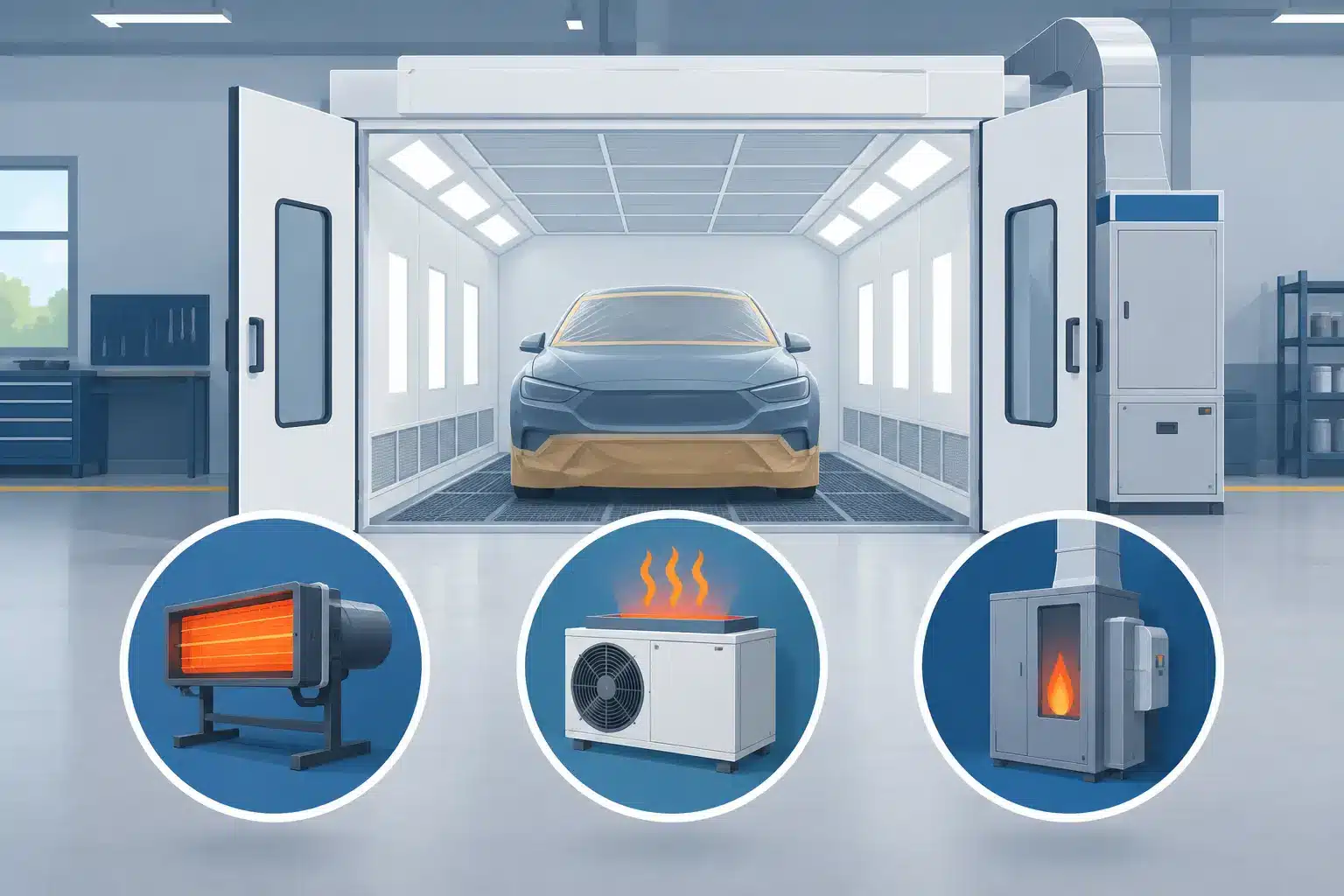
A cold booth does more than make operators uncomfortable. It can extend flash-off times, affect paint flow and finish quality, slow production, and make reliable curing difficult during a UK winter. Choosing between spray booth heating options therefore needs more thought than selecting the largest burner or the lowest quoted running cost. The heat source must work with the booth’s airflow, coating system, duty cycle and building services.
A well-designed installation treats heating, extraction and air replacement as one system. The aim is to maintain the required working temperature while delivering clean air, controlling vapours and providing the airflow needed for safe spraying and effective drying.
What the heating system needs to achieve
Most professional booths operate in more than one mode. During spraying, the system needs to supply filtered replacement air at a stable temperature while extraction removes overspray and solvent vapour. During flash-off, the required airflow and temperature may change. During a bake cycle, the booth normally raises the temperature for a set period to accelerate curing, subject to the paint manufacturer’s recommendations.
The correct temperatures are application-specific. A vehicle refinishing booth may need a controlled spray temperature and a higher bake temperature, while a furniture, joinery or industrial coating operation may work to a different schedule entirely. Water-based coatings, high-solid products, two-pack systems and specialist finishes all have their own requirements.
Heating capacity should be calculated rather than guessed. It depends on booth dimensions, air volume, extraction rate, fresh-air proportion, target temperature, external design temperature, panel insulation, door openings and heat losses through the building. A booth that performs well in mild weather may struggle badly when the outside air temperature falls.
Main spray booth heating options
Direct-fired gas heating
A direct-fired gas burner heats the incoming air stream directly. This is a widely used arrangement in professional spray booths because it can provide a high heat output, rapid warm-up and a relatively compact installation. For businesses with regular spraying and bake cycles, gas can offer a practical balance of performance and operating cost where a suitable gas supply is available.
The burner, controls and safety equipment must be specified as part of the complete booth system. Combustion conditions, airflow proving, temperature limits and purge sequences all matter. A correctly engineered direct-fired system is not simply a space heater placed near an extraction plant.
Direct-fired gas heating can be particularly suitable for larger bodyshops and production environments with substantial airflow requirements. However, gas pipework, flue arrangements where applicable, electrical supply, plant-room space and ongoing servicing must all be allowed for at the design stage. Site gas capacity should also be checked before committing to the equipment.
Indirect-fired gas or oil heating
Indirect-fired heaters separate combustion gases from the booth supply air through a heat exchanger. The burner heats the exchanger, and clean air passes around it before entering the booth. This arrangement may be selected where the process, customer specification or site conditions call for separation between combustion products and the air supplied to the working area.
The trade-off is that indirect systems are generally less thermally efficient than direct-fired alternatives, because heat is transferred through the exchanger and flue losses must be considered. They can also require more installation space and a suitable flue route. That said, they remain a sensible choice for many specialist finishing applications.
Oil-fired indirect heating may be considered where gas is unavailable, particularly at rural or older industrial sites. Fuel storage, delivery access, emissions, maintenance and price volatility should be part of the decision. It is often an effective solution, but it should not be treated as a like-for-like replacement for mains gas without reviewing the whole installation.
Electric heating
Electric heating offers straightforward control and avoids on-site combustion. It can be useful for smaller booths, low-volume operations, occasional-use facilities or sites where gas is not available. Electric elements can also suit controlled drying rooms and compact finishing spaces where the heating load is modest.
The main constraint is usually running cost and electrical capacity. A booth moving large volumes of air needs significant energy to raise incoming winter air to spraying or baking temperature. Before choosing electric heat, the available supply, maximum demand, distribution equipment and likely tariff should be assessed properly.
Electric heating is not automatically the low-maintenance or low-carbon answer in every case. Its suitability depends on how often the booth runs, how much fresh air is required, whether recirculation is used during approved operating stages, and the source and cost of the site’s electricity.
Heat pumps and heat recovery
Heat pumps are attracting interest as businesses look to reduce fossil-fuel use. They can work well in some finishing environments, especially where heating demand is steady, temperatures are moderate and the building has been designed to retain heat. They may also provide useful heating for adjacent preparation, drying or workshop areas.
Their limitation is temperature lift and response time. A spray booth can require large amounts of heat quickly, particularly when bringing cold replacement air up to a baking temperature. A heat pump may need to be paired with thermal storage, supplementary electric heat or another heat source to meet peak demand. It is not a simple drop-in replacement for a high-output gas burner.
Heat recovery can reduce wasted energy by transferring heat from extracted air to incoming air. The design must prevent contamination transfer and maintain the extraction performance needed for the spraying process. In a solvent-handling environment, the equipment selection and safety arrangement require careful engineering. Heat recovery is often most worthwhile on high-use systems with substantial, consistent airflow.
Air recirculation changes the equation
Many modern spray booths use a controlled level of recirculated air during suitable non-spray stages, such as flash-off or baking. Reusing warmed air can reduce fuel consumption and speed temperature recovery because the heater is not continually warming cold outside air from scratch.
This must be managed through purpose-designed controls, dampers, sensors and safety interlocks. During spraying, the booth needs appropriate extraction and replacement air to control airborne overspray and vapours. The permitted operating arrangement depends on the booth design, coating materials and applicable safety requirements. It should never be improvised by closing dampers or altering controls to save energy.
A practical discussion with the equipment supplier should cover the proportion of fresh air required in each mode, the temperature ramp, bake hold time, airflow set points and changeover between spray and bake. These details affect both finish quality and energy use.
Match the heat source to the process
The best option is usually driven by the work being carried out, not by a single headline specification. An accident repair centre completing several bake cycles a day may prioritise fast recovery, dependable high output and low cost per cycle. A bespoke furniture maker spraying a few items each week may place greater value on stable low-temperature conditioning and modest capital cost.
For industrial manufacturers, production pattern is often decisive. A booth operating for long shifts has a different energy profile from one used in short batches. Consider whether components enter the booth cold, whether doors are opened frequently, whether spraying is continuous, and whether a separate drying room could take work out of the booth sooner.
The coating supplier’s technical data should also be part of the specification. Forcing a finish through a faster, hotter cycle than recommended can create defects rather than productivity. Good heating design supports the coating process; it does not override it.
Installation and operating details that are easily missed
A heating system only performs as intended if the surrounding equipment is right. Insulated booth panels, well-sealed personnel doors, correctly sized supply and extract ductwork, clean filters and properly balanced airflow all affect heat demand. Dirty intake or extract filters increase resistance, reduce airflow and can make temperature control less consistent.
Controls deserve the same attention as the burner or heater itself. Operators need clear selection of spray, flash-off and bake modes, sensible temperature settings, timers, fault indication and emergency shutdown arrangements. Automatic control should reduce avoidable energy use without making the process difficult to operate.
Maintenance is also a production issue. Burners, heat exchangers, fan motors, belts, sensors, filters and safety devices need planned inspection and servicing. A failing temperature probe or restricted filter can cause more disruption than a visibly faulty heater because the problem may first show up as poor paint finish or delayed curing.
For new installations, the heating design should be considered alongside the electrical supply, gas or fuel connection, plant location, access for service engineers, roof penetrations, noise control and commissioning. Retrofitting heat into an existing booth can be possible, but the airflow system and structural condition must be assessed before a heat source is selected.
The most useful starting point is a clear record of what is being sprayed, the booth’s internal dimensions, working hours, required cure schedule and available site services. With those details, a specialist can size a system around the real process rather than asking a heater to solve problems created elsewhere in the booth.
