

Spray Booth Lighting Requirements Explained

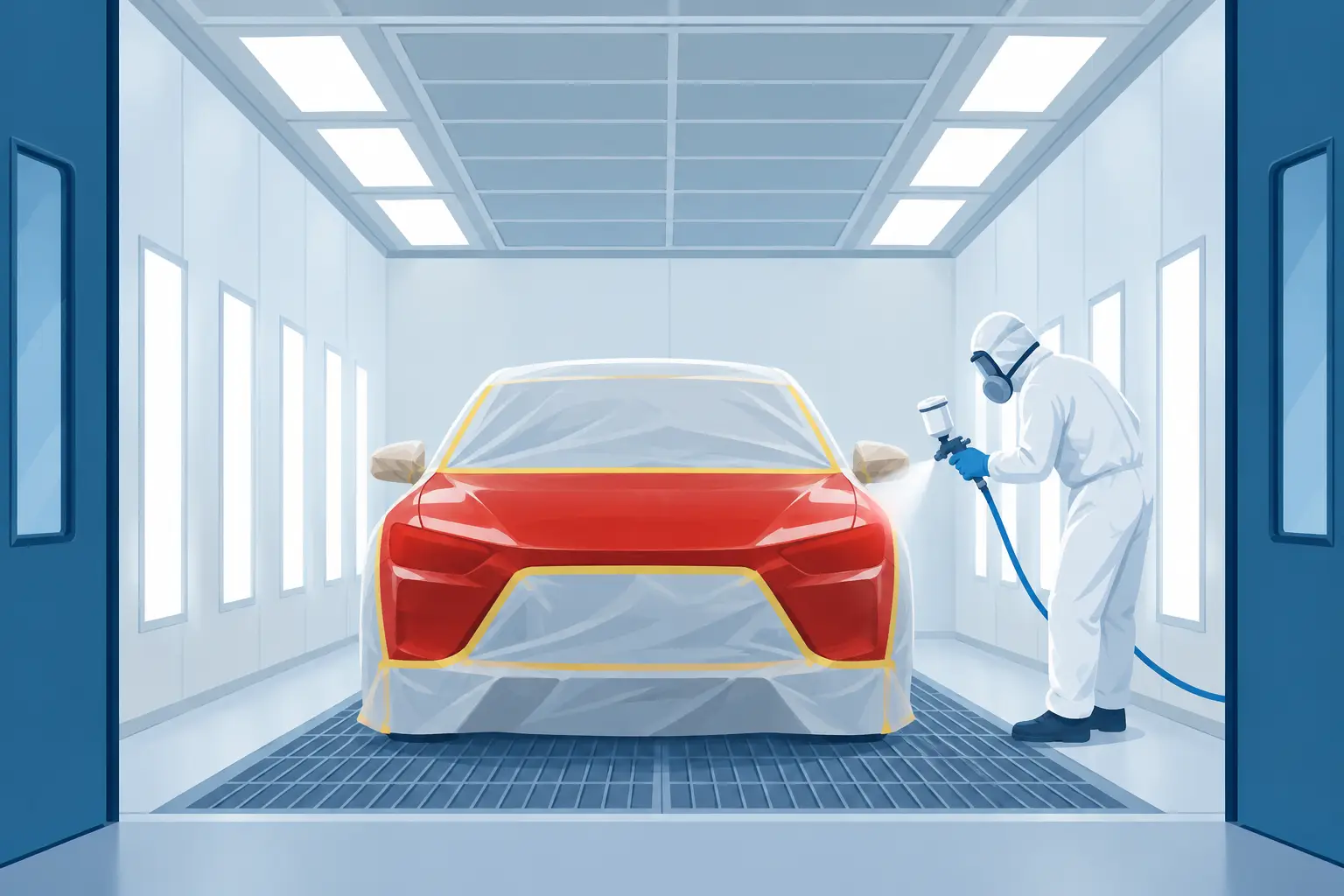
A finish can look clean under poor lighting and still fail when it leaves the booth. Missed dry spray, uneven metallics, poor coverage at panel edges and colour variation are often lighting problems before they are operator problems. Proper spray booth lighting requirements need to support accurate inspection while also accounting for electrical safety, extraction, maintenance access and the type of coating being applied.
What good spray booth lighting must achieve
Lighting in a spray booth has two jobs. First, it must give the painter enough even illumination to apply and inspect a coating properly. Second, it must be suitable for a space where flammable vapours or overspray may be present.
A high light output alone does not guarantee a good result. A booth with bright fittings concentrated in the ceiling can leave vehicle sides, lower panels, internal corners or complex fabrications in shadow. Equally, a poorly selected fitting may discolour over time, collect overspray, or create a difficult maintenance point inside the booth.
The right arrangement depends on the work. An automotive bodyshop needs consistent light across complete vehicle sides and repair areas. A joinery workshop may need clear visibility across cabinet interiors and moulded profiles. Metal finishing facilities often require strong side illumination to identify surface preparation marks, weld defects and coating coverage on shaped components.
Illumination levels: how much light is enough?
Illuminance is measured in lux. There is no single figure that suits every spray operation, but a professional spray booth should provide substantially more light than a general workshop. Many new automotive and industrial booths are specified around 750 to 1,000 lux at the working plane, with higher levels sometimes appropriate for detailed refinishing or quality inspection.
The important point is not simply the headline lux figure supplied by a manufacturer. Ask where it has been measured and whether it represents a new, clean installation or a realistic maintained level. Light output falls as covers become contaminated, lamps age and dirt builds on reflective surfaces. A design that only just meets the required level when new may become inadequate well before the fittings reach the end of their stated service life.
For large booths, illumination should be assessed across the usable work area rather than at one favourable point on the floor. The painter needs to see vertical surfaces, lower sills, roof lines and the far side of the object being sprayed. Side-wall lighting is therefore often as valuable as ceiling lighting.
Uniformity matters as much as lux
Good uniformity reduces eye strain and helps the operator judge wet edge, gloss and coverage consistently. Sharp changes between bright and dark areas can hide defects and make colour assessment harder.
A practical layout normally combines ceiling lights with angled or vertical side-wall light banks. The exact quantity and position should be designed around the booth dimensions, door locations, vehicle lift or floor arrangement, and the size and shape of the products being coated. It is not sensible to copy a lighting layout from a standard car booth into a booth used for tall fabricated frames or furniture panels.
Colour rendering and colour temperature
For refinishing work, the quality of light is as significant as its intensity. Colour rendering index, usually shown as CRI or Ra, indicates how naturally colours appear under a light source. A higher CRI makes it easier to distinguish small changes in shade, identify coverage issues and inspect a completed repair.
A CRI of 80 may be acceptable for some general industrial spraying, but higher colour rendering is generally preferable where colour matching and finish inspection are critical. Automotive refinishing businesses will often benefit from fittings with a CRI of 90 or above, particularly where paint formulation and final inspection take place close to the booth.
Colour temperature should also be considered. Neutral to daylight-style white light, commonly in the region of 4,000K to 6,500K, is widely used because it gives a clear working environment and supports visual assessment. The best choice depends on the paint system, surrounding inspection area and customer finish expectations. A very cool light can make a workshop feel harsh, while a warm light can distort perception of some colours.
Lighting should be matched throughout the spray, preparation and inspection process where possible. If a panel is checked under one type of light in the booth and another at the handover area, a difference in appearance may be noticed too late.
Hazardous-area and electrical safety requirements
Spray booth lighting cannot be selected in the same way as ordinary factory lighting. Solvent-based paints, thinners and cleaning materials can generate flammable vapours. Overspray can also enter or settle on unsuitable electrical equipment.
Under the Dangerous Substances and Explosive Atmospheres Regulations 2002, the employer must assess the risks created by dangerous substances and control potential ignition sources. The Electricity at Work Regulations and relevant equipment requirements also apply. The booth design should be based on a proper hazardous-area assessment, not an assumption that every fitting needs the same classification.
In many booth designs, luminaires are installed outside the spray chamber behind sealed glazed panels. This approach keeps electrical components separated from the sprayed atmosphere while allowing light into the working area. The glazing, seals, frames and fixing method must be suitable for the environment and maintained in good condition.
Where equipment is located within a classified hazardous zone, it must be appropriate for that zone and installed in line with the design and manufacturer instructions. The zone classification, paint products used, airflow arrangement and operating procedures all affect the solution. Water-based coatings may reduce some vapour risks, but they do not remove the need for a proper assessment, particularly where solvent cleaners or mixed coating systems are used.
Do not treat an IP rating as proof that a fitting is suitable for an explosive atmosphere. Ingress protection and hazardous-area certification address different issues.
Fitting construction and placement
Spray booth light fittings need to tolerate heat, vibration, cleaning and regular exposure to airborne contamination. LED systems are now common because they offer long service life, low energy use and instant start-up. However, the fitting still needs adequate thermal management and a design suited to the booth temperature, including any bake cycle.
When assessing fittings, consider the following practical points:
- sealed glazing and gaskets that limit dirt and overspray ingress;
- smooth, cleanable surfaces with minimal areas for paint residue to collect;
- fittings rated for the booth’s maximum operating and bake temperatures;
- accessible drivers, connections and lamps or LED modules for safe maintenance;
- placement that does not obstruct airflow paths, filters, doors or roof-service access.
Glazed panels should be positioned so they can be cleaned without unnecessary disruption. In a busy bodyshop, light covers can lose useful output surprisingly quickly if cleaning is left until they visibly look dirty. A planned maintenance routine is cheaper than discovering poor visibility during a high-value repaint.
Avoid glare, flicker and shadow lines
The operator should not be looking directly into an intense light source while spraying. Glare can mask surface texture and cause fatigue over a full shift. Diffused fittings, sensible mounting angles and a balanced ceiling-to-wall lighting layout help reduce this problem.
Flicker is another issue worth checking, especially with lower-quality LED drivers. Although it may not always be obvious to the eye, flicker can cause discomfort and can interfere with camera-based inspection or video recording. It is also worth confirming compatibility with any variable-speed drives, control systems or emergency lighting arrangement within the installation.
For long components, racking and overhead track systems, check the lighting plan before the booth is built. A hanging conveyor, vehicle roof rail or tall jig can create shadow lines across the most important areas of the job. In these cases, the answer may be additional side lighting, different fitting positions or a revised material-handling route rather than simply adding more ceiling lights.
Maintenance and emergency provision
Lighting performance should be checked as part of routine booth maintenance. Cleaning intervals will depend on production volume, coating type and filtration performance, but the aim is to remove contamination before it noticeably reduces output. Damaged glazing, cracked seals, failed sections and discoloured diffusers should be dealt with promptly.
Emergency lighting must also be considered as part of the overall workplace and fire-safety plan. It needs to provide enough light for people to leave the area safely if the normal supply fails, without compromising the hazardous-area design. Its position, duration and testing regime should be agreed as part of the installation rather than added as an afterthought.
A well-designed system is easier to maintain because access has been considered from the start. Before ordering, establish who will clean the fittings, how access will be gained, whether panels can be replaced without major dismantling, and whether maintenance can be completed without stopping production for longer than necessary.
When planning a new booth or refurbishment, treat lighting as part of the finishing process rather than a standard electrical add-on. The right specification gives painters a clearer view of the work, supports consistent quality and helps the booth remain safe and practical throughout its working life.
