

Choosing a Spray Booth Manufacturer for Your Site

A spray booth manufacturer should do more than supply a standard enclosure with fans and filters. The right supplier needs to understand what you are spraying, the finish you need to achieve, how often the booth will run and the limits of the building it must fit into. A booth that looks suitable on a drawing can still cause problems if the airflow, heating capacity, access or extraction route has not been properly considered.
For bodyshops, fabricators, joinery workshops and production facilities, a spray booth is a working part of the operation. It affects finish quality, throughput, energy use, maintenance demands and the practical safety of the spraying area. Choosing a manufacturer is therefore as much about design and technical support as the equipment itself.
Start with the application, not the booth model
The first question is not whether you need a full downdraught, semi-downdraught or dry-filter booth. It is what work the system must handle. A booth used for occasional repair refinishing has different requirements from one finishing commercial vehicles, kitchen doors, fabricated steelwork or large machinery components.
The manufacturer should establish the size and shape of the largest item being sprayed, the coating materials in use and the expected production volume. Water-based paint, solvent-based coatings, and specialist industrial finishes all create different demands around extraction, temperature control and filtration. The required finish standard matters too. A cosmetic automotive finish generally needs cleaner, more controlled air than a basic protective coating on agricultural equipment.
It is also worth considering the process either side of spraying. Parts may need a paint mixing room, a preparation bay, flash-off space, drying facilities or an overhead track system to move them without repeated handling. Treating these as separate purchases can create bottlenecks later. A sensible layout considers the complete route from preparation to finished item.
What a spray booth manufacturer should assess on site
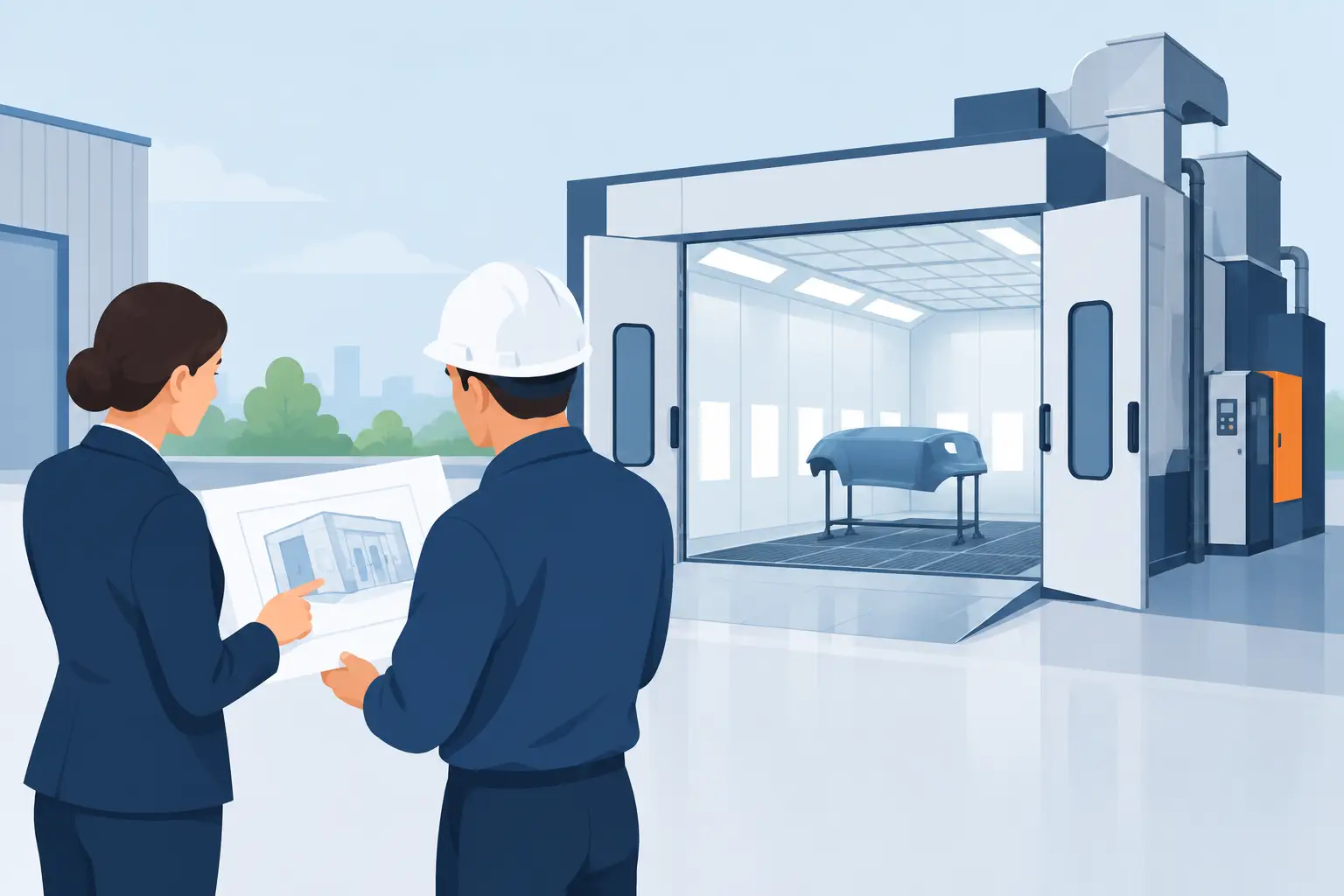
A site survey is where a proposed system becomes a workable installation. Existing workshops are rarely blank spaces, and the building often dictates the practical solution.
A thorough assessment should look at clear internal height, floor construction, door locations, columns, roof structure, available electrical capacity and the route for supply and extract ducting. External space matters as well. Fans, discharge points, air handling equipment and duct runs need room, and their position can affect neighbouring premises, access ways and future expansion plans.
For a pit-based downdraught booth, the slab depth and ground conditions need careful checking before any commitment is made. If excavation is not practical, a raised-floor booth may be the better option, although vehicle or trolley access then needs ramps and sufficient surrounding space. There is no universally better arrangement – the right answer depends on the application, building and budget.
The manufacturer should also ask how equipment will be delivered and installed. Large booth panels, air handling units and duct sections may need forklift access, lifting equipment or a planned route through the building. These details are easy to overlook at quotation stage but can have a direct effect on installation time and cost.
Airflow and filtration determine more than cleanliness
Good airflow carries overspray away from the operator and the painted surface while bringing clean replacement air into the booth. The aim is controlled movement of air through the working zone, not simply the highest possible fan output.
In a downdraught arrangement, filtered air enters through the ceiling and is drawn down through floor-level extraction. This is widely used where a high-quality finish and effective overspray control are required. Semi-downdraught and cross-draught designs are the most popular type of spray booths that suit almost any type of products.
Filtration is equally important. Intake filters help prevent dust reaching the work, while extract filters capture paint particles before air leaves the system. Filter selection needs to suit the coating type and expected loading most popular choice for this would be Andreae Concertina Filters. A filter system that is inexpensive to buy but blocks quickly can increase running costs, reduce extraction performance and create avoidable downtime.
Ask how filter condition will be monitored and how easily filters can be changed. Pressure gauges or differential pressure monitoring give a clearer indication of loading than relying on visual checks alone. Maintenance access should be designed in from the outset, particularly where filters, fans or dampers are located above a booth roof or in a restricted plant area.
Heating and drying need to match production demands
A heated spray booth can improve consistency by bringing incoming air to a controlled spraying temperature. It can also reduce drying time when specified with a bake or curing cycle. However, the correct level of heating depends on the coating system, the working pattern and the desired turnaround time.
A business completing a small number of jobs each day may not need the same bake performance as a busy bodyshop processing several vehicles per shift. Similarly, an industrial coating operation may need a separate drying room or curing oven rather than tying up the spray booth while parts dry. The most efficient arrangement is not always the one with the highest temperature rating.
Fuel choice, insulation, controls and air recirculation strategy all affect running costs. These should be discussed in practical terms, using likely hours of operation rather than broad claims about savings. Controls should be straightforward enough for trained operators to select the correct spray, flash-off or bake cycle without creating inconsistency between shifts.
Safety and compliance must be designed into the system
Spraying operations can involve flammable liquids, airborne contaminants and ignition risks. The equipment specification and workshop procedures should reflect the materials being used and the hazards identified for the activity.
A competent spray booth manufacturer will discuss extraction, electrical equipment, lighting, interlocks, emergency stops and the management of flammable vapours. Depending on the installation, this may include consideration of COSHH requirements, DSEAR assessments and relevant planning, building and environmental requirements. Responsibility can be shared between the employer, installer, landlord and other parties, so it is sensible to clarify what is included and what supporting information will be needed.
Lighting deserves particular attention. Poor illumination makes it harder to see coverage, defects and metallic orientation while spraying. Well-positioned sealed lighting should provide even light across the work area without creating difficult shadows. Replacement access and lamp or LED component availability should also be considered, particularly for a booth that will operate for many years.
Look beyond the initial quotation
Two quotations may describe similarly sized booths but include very different levels of design, installation and support. Before comparing prices, check the scope in detail. Confirm the internal working dimensions, overall external footprint, airflow arrangement, heat source, filtration stages, lighting specification, door type, controls, ductwork and electrical works.
It is also useful to establish who is responsible for each part of the project. This may include groundwork, a raised base, gas connection, electrical supply, builder’s work, roof penetrations, fire precautions and final commissioning. A clear scope reduces the risk of late additions that make an apparently low-cost proposal more expensive.
Aftercare should be specific rather than vague. Ask about commissioning, operator familiarisation, planned servicing, spare filters and parts availability. Fans, burners, drives, sensors and controls all need support over the life of the installation. If a production-critical booth stops, the quality of technical response matters as much as the original equipment price.
Questions worth asking before you place an order
A useful supplier should be able to answer straightforward questions clearly: What vehicle or component size is the booth designed around? What airflow path will it use? How will filters be accessed and monitored? What does the installation require from the building? Which services are included? How long will commissioning take, and what routine maintenance is expected?
The answers should relate to your site and process, not just a catalogue specification. If the proposed booth is larger or more complex than your actual work requires, it may impose unnecessary installation and energy costs. If it is underspecified, the saving can disappear through poor finish quality, restricted throughput and repeated maintenance.
APEX Coating Systems approaches projects by matching the spray booth, extraction, drying and handling equipment to the work being carried out and the constraints of the premises. That practical discussion should happen before the order, when changes to layout and specification are still straightforward.
The best time to challenge a spray booth proposal is before installation begins. Measure the real work, map the movement of people and parts, and ask for the technical reasoning behind each major choice. A system designed around those facts is far more likely to support reliable finishing work for years to come.
