


How to Choose Spray Booth Size for Your Workshop

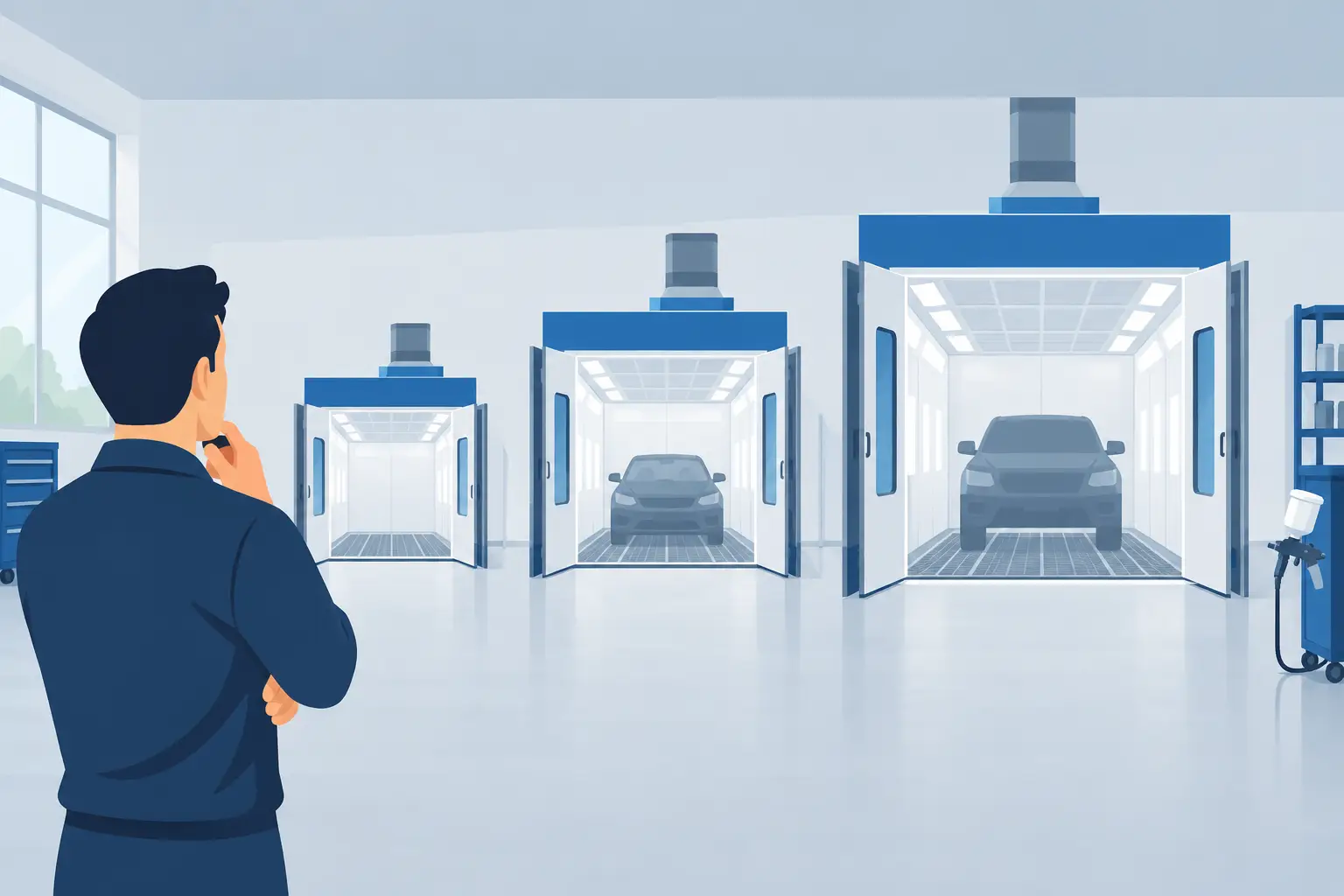
A spray booth that is too small quickly becomes a production bottleneck. Parts cannot be positioned safely, operators work too close to walls or filters, and vehicle doors may not open fully. A booth that is unnecessarily large has its own cost in floor space, heating demand and capital outlay. Knowing how to choose spray booth size means looking beyond the dimensions of the item being painted and considering the complete working process around it.
For a bodyshop, that may mean allowing room for vehicle access, panel preparation and drying. For a fabricator or joinery manufacturer, it may mean accommodating long workpieces, trolleys, overhead tracks or hanging racks. The right answer depends on what is being sprayed, how often it is sprayed and how material moves through the workshop.
Start with the largest item you need to spray
The largest item is the correct starting point, but it should not be the only measurement used. Record its length, width and height in the orientation it will be sprayed. Consider occasional work as well as everyday production. If a workshop normally paints small fabricated parts but regularly receives machine guards, gates or frames, sizing only for the small items can create an expensive limitation.
For vehicle refinishing, measure the largest vehicle type you intend to bring into the booth, including mirrors and open doors where relevant. A booth suitable for small cars may be impractical for vans, pick-up lorries or long-wheelbase commercial vehicles. If larger vehicles are only a rare job, it may still be sensible to plan for them if they are profitable and fit the business direction.
In industrial finishing, do not overlook fixtures. A component may be compact until it is mounted on a jig, suspended from a rail or placed on a wheeled trolley. The effective size is the component plus its handling method.
Add working clearances, not just empty space
A part should not fill the booth. Operators need enough clearance to move around it, maintain a suitable spray distance and keep hoses, equipment and clothing away from wet surfaces. They also need a safe, practical route to enter and leave the working area.
As a planning rule, allow working space on all sides of the item. The exact allowance depends on the coating process and whether one or two operators are spraying, but the principle is consistent: the painter must be able to reach every face without overreaching or repeatedly repositioning the job.
Height deserves the same attention. Leave clearance above tall items for spray access, lighting and airflow. Where overhead track systems, lifting equipment or hanging conveyors are planned, their rail height, hooks and load movement need to be included from the outset. A booth may look adequate on a floor plan yet be too low once a suspended component is introduced.
Think about doors and loading routes
The booth door opening must accommodate the item as it arrives, not merely fit it once inside. Measure the widest and tallest point that must pass through the doors, including transport trolleys, pallet bases and lifting attachments.
Also check the route from the loading point to the booth. A wide booth is of little use if a finished assembly cannot turn through a workshop aisle, pass a support column or clear a roller shutter. For vehicle booths, consider approach angles and whether the driver can enter and exit without awkward manoeuvring.
Match booth size to production volume
Two businesses can spray the same product and need very different booths. A low-volume specialist may prioritise flexibility and a compact footprint. A manufacturer coating parts throughout each shift may need space that supports continuous loading, spraying, flash-off and unloading.
Ask practical questions about the working day. How many jobs need to be completed per shift? How long does each job spend in preparation, spraying, flash-off and cure? Does the booth need to be available for the next job while the previous coating is drying? Are colour changes frequent?
If the booth is used for both spraying and drying, its occupied time is longer than the actual application time. A separate drying room can free the booth sooner in some operations, although it requires additional space and equipment. Equally, an integrated heated booth can be the better choice where floor space is limited and throughput is moderate.
Do not size solely for current order levels if expansion is likely within the life of the equipment. However, avoid buying capacity on the assumption of growth that has no operational plan behind it. Larger enclosures require more air movement and, where heated, more energy to bring the working volume to temperature.
Size airflow and extraction with the enclosure
Booth dimensions, airflow and extraction design are closely connected. As booth volume and open face area increase, the ventilation system must be designed to maintain the required air movement through the spraying zone. Simply making an enclosure larger without properly matching the fan, ductwork, filters and air replacement arrangement can result in poor capture of overspray.
The airflow pattern also matters. A cross draft booth moves air horizontally across the working area, while downdraft and semi-downdraft designs move air downwards to varying degrees. Each arrangement affects pit requirements, building work, vehicle access, filter location and the way overspray is managed.
A larger booth is not automatically better for finish quality. Excessive space with poorly considered air distribution can create dead areas or uneven airflow. Conversely, a compact booth can perform very well when its dimensions suit the work and the extraction system is correctly engineered.
For this reason, equipment selection should be based on the intended application, coating type and process rather than a generic airflow figure. Solvent-based and water-based coatings, high-build products and specialist industrial finishes can all place different demands on filtration, air replacement and drying.
Plan the booth around the workshop, not in isolation
The footprint on a drawing is only one part of the installation. A spray booth needs room for ducting, fans, control equipment, filters, access panels and routine maintenance. Heated systems may also require space for associated plant. If a pit or raised floor is part of the design, construction depth and drainage considerations need to be assessed early.
Leave enough access to change filters, inspect extraction components and service motors without dismantling other workshop equipment. Poor maintenance access often leads to delayed filter changes, reduced extraction performance and unnecessary downtime.
The surrounding layout should support a logical process. Ideally, work moves from preparation to spraying, then drying, cooling, inspection and dispatch without crossing busy traffic routes. Paint mixing rooms and preparation areas should be positioned with safety, workflow and housekeeping in mind. A booth placed wherever there happens to be a spare rectangle of floor can create congestion for years.
Utilities also influence what is practical. Confirm available electrical supply, gas provision where applicable, compressed air capacity, building structure, roof penetrations and discharge routes for extracted air. Early site assessment can identify constraints before a preferred booth size becomes fixed.
Consider the type of work being carried out
Different applications need different proportions and layouts. A vehicle refinish booth must allow for vehicle positioning, door operation and even lighting around curved bodywork. A furniture booth may need length for doors, cabinetry or assembled units, plus racks that keep coated pieces separated. Metal fabrication businesses may need width and height for frames, balustrades, agricultural equipment or fabricated assemblies.
Where long parts are handled, a narrow but extended booth may be more useful than a square enclosure. Where large items are rotated on stands, width is often the critical dimension. If several small components are sprayed on a trolley or rack, consider the full rack envelope and whether it can be turned inside the booth.
It is also worth deciding whether the booth needs to handle one large job or several smaller jobs at once. Multiple jobs can improve throughput, but only if operators can access them properly and avoid overspray transfer between pieces.
Avoid common sizing mistakes
The most common mistake is measuring the product but not the people, equipment and movement around it. The next is treating the door opening as an afterthought. Another is overlooking future work, particularly when a business is moving into larger vehicle repairs or more substantial fabricated products.
Other problems arise when a booth is specified before the wider process is understood. A booth may be physically large enough but still fail to improve throughput if there is no preparation capacity, no place for finished work to cool or no practical route for materials to enter and leave.
A site survey and process discussion are more valuable than choosing a standard size from a brochure. APEX Coating Systems assesses the item being coated, handling method, workshop constraints and intended output so the booth dimensions support the actual operation.
A practical way to brief a supplier
Before requesting a proposal, prepare a simple set of information: the dimensions and weight of your largest parts, photographs of the current workspace, expected daily or weekly volume, coating materials, drying requirements and a rough workshop layout. Include any planned trolleys, overhead tracks, vehicle types or lifting equipment.
This gives the supplier a realistic basis for recommending internal dimensions, door arrangement, extraction layout and associated equipment. It also makes it easier to compare quotations on the right basis rather than comparing only overall booth size or purchase price.
The best spray booth size is the one that gives operators room to do consistent work safely, fits the building realistically and supports the production level you intend to achieve. Start with the biggest job, then follow its route through the whole process. That approach usually reveals the dimensions that matter most.
